Jim Hightower’s Radio Lowdown

Friday Signpost: Hightower & Tavis Smiley on the Fight for Fundamental Fairness

Last week, Hightower had the absolute pleasure of appearing on Tavis Smiley’s live radio talk show—a lot of great laughs, and a lot of good ground covered! From the Texas races, to America at 250, to the idea that fundamental fairness is a sense all humans share, Tavis and Hightower went deep. Tavis and his team have given us permission to share it with you here, and we’re so grateful—he’s also just started his own Substack newsletter, and we encourage you to subscribe to one of the greats of American media at tavissmiley.substack.com. You can also listen live on KBLA 1580 daily, and subscribe to his podcast. —dz

Transcript

Edited lightly for clarity

Part 1

Tavis Smiley: Tavis Smiley, glad you’re with us in the second hour of our program here today.

Yesterday, we stepped into what I call the Elders’ Skybox to talk to Dr. Johnette Cole. She was absolutely amazing yesterday. If you missed that conversation with Johnnetta Cole yesterday, I encourage you to check out the podcast, now posted. She, of course, is the legendary, the iconic, first African American woman to be president of Spelman. But she’s covered so much ground in her amazing career, and she joined us yesterday on the show. And Johnnetta Cole still got it. I mean, she was just blazing yesterday. So if you missed the conversation with Johnnetta Cole yesterday, I encourage you, you will not be disappointed. Check out the podcast, now up, of our dialogue with Dr. Cole yesterday.

So we stepped into the Elders Skybox again today to talk to our friend and brother Jim Hightower, the legendary talk show host down in Texas. I quote him oftentimes. When you hear me say that the only thing you find in the middle of the road is a dead armadillo, that was Jim Hightower years ago, and I’ve never forgotten that line from all those years ago. You can’t be middle of the road. We were just talking about that in our hour with Dr. Kaye Wise Whitehead about Hakeem Jeffries and some of these Democrats who, on a number of issues, still want to occupy the center, the middle of the road. That is not where one needs to be, especially right about now. Pick a side. Pick a side is my point. And that was Jim Hightower’s advice many, many years ago. I never forgot when he said it, and I’ve held on to it all these years.

I invited him on today to talk about this hot Texas Senate race, but more broadly to get his take, as a longtime progressive, on the march that we are witnessing in real time by these progressives after decades of being in the wilderness. With all that said, I’m honored to welcome Jim Hightower to this program. Jim, how are you, sir?

Jim Hightower: I’m doing great, Tavis, and all the greater because I get to visit with you.

Tavis Smiley: It’s my honor to have you on this program. Thank you for those kind words. I meant what I said earlier about having listened to you. I’m at that age now. I just turned 62 a couple of days ago, and I’ve been at this, what, 35 years. My mom teases me about it, but people come on the show all the time: “Mr. Smiley, I grew up listening to you, I grew up watching you.” So I’m at that age now where I’m getting that. And this is funny, because I can say that to Jim Hightower now. I grew up listening to him and watching him, and so I’m thrilled to have him on this program.

Let me just start with this, broadly speaking. I’ve asked this question of other guests. I’ve got two minutes now, we’ve got the rest of the hour when we come forward, but in these first two minutes, I’m asking you the same question I’ve asked of others. We are inside that eight-week sprint from Labor Day to Election Day. How are you feeling?

Jim Hightower: I am feeling more upbeat than I have been in years about Texas politics. Our party has finally come alive down here, as you just indicated. We’ve had too many corporate centrists trying to dominate our party, thinking we can fool the people if we just tiptoe around our progressivism, rather than recognizing that people themselves are progressive. And if we talk to them in that kind of language, they might respond to us in a more favorable way than they have in the past, or respond at all.

I would point out, first of all, Tavis, that Texas is not a right-wing state. It is not a Republican state. It is a non-voting state. And it has not been voting because the Democratic Party, my party, has been over in the ditch somewhere, trying not to be discovered, rather than recognizing that most people are quite progressive. I think of it in terms of my own father, who kept up with politics, but he was not political, particularly. He didn’t know he had a political philosophy, but he did, and it was expressed to me many times in these words. He said, “Jim, everybody does better when everybody does better.” And that is what the Democratic Party is supposed to represent.

And so that spirit is coming back within the Democratic Party. We have it with James Talarico running for Senate, Gina Hinojosa running for governor, but also let us not forget those down-ballot candidates, who can make such a difference in a campaign. I’ve been one of those myself, so I can attest to it. And we have a terrific lineup this year, including Clayton Tucker running for agriculture commissioner, a position that most people wouldn’t pay a whole lot of attention to until you realize, wait a minute, if you eat, you are involved in agriculture. And we need to make that political as well as edible.

Tavis Smiley: Love it. He’s already on a roll. That is the Jim Hightower that I grew up listening to. He’s wise, he drops these one-liners; as we say these days, he’s dropping bars. I love his father’s edict that everybody does better when everybody does better. It’s so simple. But I want to give him some time to unpack this. I want to interrogate this notion that people themselves are progressive. People themselves are progressive. That line resonated with me; I suspect it did with you as well. I’ll let him unpack that and a great deal more. I’m glad to have Jim Hightower for the hour on Tavis Smiley.

Tavis Smiley, and longtime progressive activist, legendary talk show host, bestselling author Jim Hightower. So we’ve stepped into the Elders Skybox to tap into his wisdom in this hour as we are hurtling inexorably toward Election Day on Tuesday, November 3rd. Wanted to check in with him on some national issues, but certainly everybody’s watching this Senate race in Texas. I talk to my friends down there all the time, and they are so excited about turning Texas blue. You heard Jim Hightower say a moment ago that Texas is not a Republican state, it’s not a red state, it’s a non-voting state. I’ll let him unpack that as we move through this hour.

But just some quick updates here. So you saw the Republican convention, that two-day farce they had down in Texas not long ago. Since that convention, a new poll has come out about the race in Texas. Interestingly, the survey happened on September 13th. That was Sunday, my birthday. And it’s good news for James Talarico. The latest poll, this is the SoCal Strategies poll, shows Talarico leading Paxton 50 percent to 45 percent. It’s a five-point margin. There had been a two-point lead by Paxton over Talarico. It’s fascinating. So before the convention, Paxton was leading Talarico by two points in Texas. Post the convention, it flips. Talarico is now leading Paxton by five points. Not sure what Ken Paxton did or said at that convention that made these numbers flip. Obviously it’s very, very tight, and these polls are snapshots in time. We still have weeks to go before Election Day. We’ll let Jim Hightower unpack a bit more about the tightness of this race in Texas in this hour.

But I want to start right now, Jim, where we left off moments ago, and that is with your suggestion that people are themselves a great deal more progressive than we acknowledge or give them credit for. We’ve got time. Unpack that for me.

Jim Hightower: Well, just go back to your childhood. The very first political expression of a child, maybe at two years old, is “That’s not fair.” That is a powerful political sentiment, and it’s within all of us. And that’s what we’re seeing today. The unfairness of the billionaires with their data centers invading our communities. The unfairness of the destruction of voting rights, period. Not just the Voting Rights Act, but voting rights. The unfairness of economic plutocracy, really, and just a general unfairness that pervades our society, including the election itself.

The idea that money can control. That happened to Texas, just as it did nationally, in the 1980s, when Tony Coelho, a member of Congress from California, decided that the Democrats didn’t need to have all this grassroots stuff. We could just get money from rich people and throw it at television ads, and then we could compete with the Republicans. And the powers that be in the Democratic Party here in Texas agreed with that. So they began to shift away from what Ann Richards and myself and Jim Mattox and Garry Mauro and other good, solid Democrats were winning elections with: a focus on the grassroots people of our state. That got abandoned. Instead they turned to money.

And when you turn to money, I can tell you, if you get a corporate check, written on the back of it is the corporate agenda. And they’re going to cash that check, not you. That is what happened to Texas. The Democrats quit being Democrats because, well, we don’t want to upset those money people, so we’ll just tone down our message. And by toning down the message, we tone down our public support, our people’s support. If we weren’t standing for them, why would they stand for us? And so that’s what happened. Our solid Democratic constituencies, which were farmers, working-class folks, teachers, environmentalists, didn’t hear themselves in the Democratic message. So they quit voting. It’s not that they turned Republican.

We consistently had among the top one or two worst voting records in the country in the state of Texas. We have the lowest turnout in our country. Ken Paxton, you just mentioned, is now running for the U.S. Senate on the Republican ticket. Paxton got 68 percent of the Republican primary election that made him their nominee. Sixty-eight percent, boy, that sounds good. He must be very popular, until you realize that is 3.4 percent of the voters of Texas. That’s who nominated him. That’s his basic support: 3.4 percent. Can we not get 3.5 percent? Well, maybe if we began to organize and mobilize and strategize and do something a little stronger than we had been doing.

And that’s the good news in Texas. That’s what has changed this election cycle over previous ones: our Democratic Party, with a new party chair, and a dynamic bunch of candidates running for statewide office and local office as well. We used to have 50 counties in our state that had no Democratic Party chair, much less a Democratic committee. We had state legislative district after district that had no Democratic contender in it. So we weren’t even running. But this year we do. We have candidates, good candidates, in all of those districts. We have vibrant party building in every county in the state. You have to have the infrastructure. It’s not just handsome candidates like myself, or smart and sassy people, that make the difference. It is grassroots, fundamentally. And if you abandon the grassroots, then there’s no one to appeal to.

Part 2

Tavis Smiley: Let me ask you this. You said a few things, and I want to go back to them right quick. You’re on a roll, and that’s what he does every day, and I love it. I just have to keep up with him. Let me start with the money. No naiveté here, but my sense is, even though we’ve seen efforts, I think of McCain-Feingold, other efforts we’ve seen over the years, my sense is that at this point that horse has left the barn, and I can’t imagine how we get money out of our politics. Citizens United, I can do this all day long, as you could, Jim Hightower. But that trade-off that Democrats made to get access to that money, there’s no 180 on this. I mean, the Democratic Party is so broke now, as you know. The national Democratic Party is so broke, they’ve been borrowing money. So even though your indictment about the money in our politics is spot on, can you imagine any way to get money out of our politics at this point?

Jim Hightower: Yes, I can, which is to go to the people with it. It is the most popular polling issue in America and has been for some time: getting corporate money out of politics. It’s up at the 90 percent level, including something like 75 percent of Republicans who want to get this corporate money out of our system. So we have the base of support, but we have to have a politics that goes out there and collects that base. And that means running on it again. Our party nationally has quit running on that issue. So we’ve abandoned one of the very best issues we have, an issue of abject plutocracy over democracy, money over people.

And that is what’s beginning to change. That’s why Talarico is up there, running as our Democratic candidate for U.S. Senate. He has raised a ton of money, outraised Paxton himself, because he’s getting small-dollar donations from people who are mad as hell about money in politics and how government serves money, not people. And again, Clayton Tucker, running for agriculture commissioner, has a theme that says to beat money power, you have to have people power. You have to organize people against organized money. That is a winning topic, and candidate after candidate around the country this time are beginning to grasp that and make hay with it.

Tavis Smiley: Let me ask you this. The other thing you said, I want to come back to it. You’re saying so much that’s just jumping out at me. I want to come back to this notion of fundamental fairness. I find myself time and time again over the course of my career, Jim, on any number of issues, making the point that it’s ultimately about fundamental fairness. Pick the issue, and my moral stance on so many of these issues is that it’s ultimately about what I term fundamental fairness.

And I loved your suggestion that one of the first things that comes out of our mouths as kids... I don’t know where we get this, but when you said it, I smiled. I’m sure every parent listening to this program right now smiled. We’ve all heard kids say, “That’s not fair. That’s not fair.” I don’t even know where that comes from, but we’ve all heard babies say that line. So I’m glad you used that.

I’m wondering whether or not, in this moment, you believe that everyday people in this country care about fundamental fairness. And before you answer, here’s my point. I think that we’ve become more nativist for a lot of reasons. People are turning inward, they’re lashing outward. I’m not sure that we actually believe in meritocracy anymore. We see Donald Trump and the big grift. We see him not playing the game by any set of rules that speaks to any kind of fairness. We see the Supreme Court putting its thumb on the scale in favor of Donald Trump too often. We see a Congress that’s doing nothing; they’re letting Donald Trump run roughshod. In the legislative branch, the executive branch, or the judicial branch, I don’t see any semblance of fairness. Tell me whether or not you believe that everyday people in this nation still believe in the notion. Never mind what we say as a two-year-old: as adults, do we believe in fundamental fairness?

Jim Hightower: Yes, we do. And in every case that you mentioned there, Trump being a sleaze, Congress not taking any action, the Supreme Court being a corporate subsidiary, et cetera, their popularity has declined in direct proportion to their abandonment of those values of fairness. That still is within the people. We don’t appeal to it. For the most part, we’ve not had a politics nationwide that appeals to that fairness issue. But again, I think it is so fundamental that it is the core of reestablishing a people’s democracy in our country: just to focus on that fundamental issue of fairness.

You know, again, back to my upbringing in the little town of Denison, Texas. My parents taught egalitarianism. They didn’t know what that word was. Probably couldn’t spell it, you know. But they understood it. What they said to me was, “Nobody is better than you, and you’re not any better than anybody else.” Again, those are powerful moral sentiments that are deeply imbued, I think, in the human experience.

And you see it as people rebel against the privatization of our schools, as people rebel against the monopolization of our food economy, our energy economy, any basic economy you want to talk about, controlled by a handful of billionaires. You see it in the public disgust with Elon Musk and Peter Thiel and Jeff Bezos and these sorts of billionaires who seem to think that because they’ve got money, they’ve got brains, and they can just run things. But you can’t run over the American people. You know, Lincoln said it: you can fool some of the people all the time, and all the people some of the time, but not all the people all the time. And I think those people are on the move.

And again, if we have a politics that appeals to “we’re going to be a unified country that believes in egalitarianism, that believes in fairness, that believes in economic justice, social justice,” then people will respond. They won’t respond to those words, but they will respond to the reality that you put forward. Here’s what we mean by that.

Part 3

Tavis Smiley: I hear it, I hear it. Jim Hightower, still on fire all these decades later. As I said earlier, in case you’ve just tuned in, people tell me all the time, “I grew up listening to you, I grew up watching you,” and I can say that about Jim Hightower, and now you see where I got it from. So much of the way I approach these issues I learned from Jim Hightower. He just speaks plain. I call it KISS MIP: keep it simple, make it plain. KISS MIP, keep it simple, make it plain. I love his parents’ edict that everybody does better when everybody does better. There’s a reason why he is the legendary Jim Hightower. You see why I want him on this program. I hope when I achieve his age, my mind is still as sharp as his and still on point the way his is. I am honored to have another half hour with Jim Hightower when we come forward on Tavis Smiley.

I just saw the numbers. People are signing up by the hundreds to join us on Saturday, October 3rd. I’m inviting you once again, right now: mark your calendar. This is history in the making, the California Voices Town Hall and Ballot Forum, live from L.A., 8 a.m. to 5 p.m. All the candidates are showing up, and you should too. The event is free, but you must register. Go to KBLA1580.com right now and get your seat. California Voices, Saturday, October 3rd. Come be a part of history, brought to you by KBLA Talk 1580 and the Community Voter Education Project.

And this is what I call wisdom speaking. Wisdom speaking. I am honored to be in conversation with the legendary, the iconic talk show host Jim Hightower, New York Times bestselling author, syndicated columnist, who has his own Substack called the Hightower Lowdown that I encourage you to sign up for: the Hightower Lowdown on Substack, by Jim Hightower. He’s still dropping bars as often as he can. And again, I’m just thrilled to have him on this program for the hour. In case you missed the first half hour, you missed a good one. I love this homespun wisdom that he’s sharing with us. There are thankfully a few more minutes to go in this dialogue, but check out the podcast of the entire conversation, posted later this evening, if you missed any of the brilliance of Jim Hightower in this first half hour.

I want to play a clip for you. Jim and I were talking a little bit ago about the Republican convention, the midterm convention, the first time in 50-plus years that somebody did one of these in the midterms. And it was in Texas, of course, in Dallas. James Talarico is running for Senate in Texas as a Democrat against Ken Paxton. He didn’t go to the convention, but post the convention, Talarico got a bump. Typically the guy featured at the convention gets a bump. Didn’t work that way. Paxton did not get a bump. Post the convention, the poll indicates that Talarico is now leading Paxton in Texas by five points.

If you were listening earlier, you heard Jim Hightower say that Texas is not a red state, not a Republican state, it’s a non-voting state. And when you break down the numbers, as he did so brilliantly earlier, you’ll see that Texas really is a non-voting state. I was thinking, when Jim was making that point, that if we did the data on every state, we may find out that most of these 50 states are not blue or red. They’re all non-voting states. It ain’t just Texas. I think Jim is on to something. We should stop this red and blue nonsense, even the purple nonsense, and just call them non-voting states. Jim Hightower once again is giving us something to think about.

But Talarico gets a bump out of their convention. He goes up. He’s up by five points right now. So all of my friends in Texas are excited about the chance for Texas to turn blue this time around. We will see if Talarico can pull that off.

But back to that convention. I want you to listen very carefully. I’m just setting this up now. There was a heckler at this convention when Ted Cruz was speaking. And maybe heckler is the wrong word, because in the Black church we say you’ve got your amen corner. So I’m not sure he’s a heckler as much as he is an amen corner for Ted Cruz, who did nothing to chin-check this guy, to stop this guy from what he was saying repeatedly while Ted Cruz was speaking. Cruz heard it loud and clear. You can hear it on the tape. And at no point did Ted Cruz stop to correct him. But listen to Ted Cruz, and just listen very carefully. You’re going to hear it two or three times; see if you can’t pick it out for yourself. Give it to me, Miles.

Ted Cruz (audio clip): When Mamdani says he wants to seize the means of production, he means it. When Abdul El-Sayed says he has a quote “obligation to comply with Sharia law,” he means it. And when James Talarico says he wants to dismantle capitalism, he means it.

Tavis Smiley: Have Miles play it one more time. I want you to hear it now. I’ll tell you exactly what you should have heard. Every time he calls out the name of Mamdani, then Abdul El-Sayed, then James Talarico, there’s a guy standing not too far from Ted Cruz who yells out, “He should be shot.” Mamdani: “He should be shot.” Abdul El-Sayed: “He should be shot.” James Talarico: “He should be shot.” Now listen again; see if you hear it.

Ted Cruz (audio clip, replayed): When Mamdani says he wants to seize the means of production, he means it. When Abdul El-Sayed says he has a quote “obligation to comply with Sharia law,” he means it. And when James Talarico says he wants to dismantle capitalism, he means it.

Tavis Smiley: Going back, Jim Hightower, to all of the pronouncements made after the death, the murder, of Charlie Kirk, and now on national television, at a Republican convention, you have someone yelling three times, no less, “He should be shot, he should be shot, he should be shot,” and ain’t nobody said nothing about it, Jim Hightower.

Jim Hightower: Yes, the silence is the evil. And that’s all about Trump. You know, almost no Republican will stand up and say Trump is just full of it. He is espousing hatred, he is espousing misogyny, he is espousing racism, he’s espousing xenophobia. He’s espousing everything that America is against. Everything America stands for is being rejected by Ted Cruz and Ken Paxton and Donald Trump, et cetera. You know, I heard on TV recently, Tavis, some Republican saying about Ted Cruz, “Well, you know, sometimes Ted is his own worst enemy.” And I said, “Not while I’m alive, he’s not.”

We have to take on these people. We progressives can’t just say, “Well, they’re just talking.” No, they’re not. They’re spewing a doctrine of hatred and of violence, really, as you just portrayed in that amazing work of audio technology that you pulled off. It’s very, very telling. And again, you know, I keep coming back to the positive side of it. That is not America. That’s what gets portrayed most, but that is not who we are.

Part 4

Tavis Smiley: Not who we are. You see why I love Jim Hightower. I mean, he said Ted’s his own worst enemy? Not as long as I’m living. I love, love, love Jim Hightower. All right, and that’s why I invited him on this program for an hour. Let me circle back, Jim, to something else you said earlier, and actually I opined on it myself. I thought about what you said during the break. Based on your analysis and based on your framing, Texas ain’t the only non-voting state. So why are we stuck on this red, blue, sometimes purple narrative when the truth is that all of these states are non-voting states?

Jim Hightower: Yes. Well, the media, the political consultants, they’re the ones who drew this red-blue color map on us. And it is not true. It has never been true. I’ve got a great story from my campaigning days of going into an area with people who are supposedly right-wing, and being able to talk to them. And we have candidates today doing that. Talarico is doing it, Clayton Tucker is doing it, Gina Hinojosa is doing it: going into areas where people have been told, “You’re right-wing,” and they’re saying, “Wait a minute, we like what this person is saying. Can’t we talk about that?” And so we just have to keep saying it. But that requires, Tavis, that we go back to grassroots people politics again, to where we’re talking to the people, not talking through consultants and PR people.

You know, I’ll tell you, today I’m sitting in my kitchen in Austin, Texas. But I live on the south side of Austin, and we’re a little more irreverent over here. We’re just a little more spunky. In fact, our slogan over here is “We’re all here because we’re not all there.”

Tavis Smiley: I love Austin, and I’m glad to know that you are in that part of town. As a matter of fact, Austin’s my favorite city in Texas. I didn’t realize that until 25, 30 years ago, when I started going to the Texas Book Festival, one of the best book festivals in the country. I’ve been honored to be invited to speak there a number of times over the course of the 24 or 25 books I’ve written. I’ve been going to the Texas Book Festival for years. It’s in Austin, the state capital. And I remember the first time I went there, I wanted to know where Barbara Jordan sat. That’s what I wanted to know. In what seat did Barbara Jordan sit, before she went to Congress, of course? I wanted to find that out. But I’ve been to Austin a number of times over the years, and I like Austin. It’s my favorite city in Texas. I didn’t know that’s where Jim was today, but I’m glad to know he’s there.

When we come forward... We’ve been talking about Texas, and of course a lot of national issues, and I don’t want to color this any more than this. I want to give Jim all the canvas he needs to paint. I am curious, given all the years he’s been out here espousing these progressive POVs, these progressive points of view, what he makes of the march that progressives are on right now across the country. Call them progressives, call them DSA. What does Jim Hightower think of this march by progressives right about now? And I’m also curious to get his take more broadly on how he sees America at 250. He’s been on the front lines as a progressive fighter for a long time, but here we are, 250 years in. What does Jim Hightower make of this moment in this republic? You’re listening to Tavis Smiley.

Tavis Smiley, with Jim Hightower. Jim Hightower, you’ve been out here a long time on the front lines of this fight as an unapologetic progressive. What’s your read of, as I would term it, this progressive march literally all across the country?

Jim Hightower: Well, it is the most encouraging thing I’ve seen in a long, long time. And it is happening for real reasons, because the powers that be are running roughshod over the powers that ought to be. And people are catching on to that. So they’re beginning to rebel, and not just liberals, and not just progressives or populists like me, but everyday working people are saying, as we started our conversation, Tavis, “That’s not fair. This ain’t right. This is not America.”

And so we’ve been battling for years. We win fights. Again, you know, I was elected in the 1980s, two terms as Texas agriculture commissioner, elected with Ann Richards running for treasurer, Mattox running for attorney general, Garry Mauro running for land commissioner. We ran a unified campaign, because we could then go to people and say, “It’s not just about electing poor old Hightower here. It’s about electing a government. We can make change.” And that is what’s missing in our politics: people believing that change can actually happen. Because, as you indicated so rightly early on, Congress doesn’t do anything, the Supreme Court just follows the corporate agenda, and the White House, of course, is the mess that it’s in.

So we have to have results coming from our work. And that means a long-term view of politics. You know, I ran for office the first time and I lost. I came very close, but I lost. But I was able to turn it around, because even a losing campaign creates energy. It creates new people. It creates talent. And you can apply that to the next campaign, not just for one individual, but for many, many others. As Willie Nelson put it to me once, he said, “Hightower, the early bird might get the worm, but it’s the second mouse that gets the cheese.”

Tavis Smiley: You can’t fade Jim Hightower. You cannot fade Jim Hightower, coming with wisdom of his own, wisdom from his parents, wisdom from Willie Nelson. Love me some Jim Hightower. We’ll close this conversation when we come forward with his thoughts on America at 250. You’re listening to Tavis Smiley.

I’ve got three minutes left in this hour, which I have enjoyed immensely, stepping into the Elders Skybox. Again, yesterday Johnnetta Cole was here, former president of Spelman. Check out the podcast if you missed that brilliant conversation. And if you missed any of this dialogue with Jim Hightower, there’s so much richness in this thing, man. You’ll want to hear it again if you heard it once. And if you didn’t hear it, check out the podcast, posted tonight. You will not be disappointed in this conversation with Jim Hightower. As they say in Washington, I want to yield the balance of my time to the gentleman from Texas. I’ve got three minutes left. It’s all yours, Jim Hightower. Three minutes. Talk to me about America at 250 as you see it, my friend.

Jim Hightower: I think America is healthy in a fundamental way. It’s very active right now. You know, there are all kinds of great groups out there making fundamental changes, groups that are progressive and inclusive. And all the bad words we’re not supposed to say, again: diversity and equity. I mean, what’s wrong with diversity? What’s wrong with equity? What are they talking about? And I think more and more people are asking that. And we need to have a constant politics that asks that question. Why should we be afraid of diversity? Unless you’re a Native American, you are an immigrant. Stop pretending.

And I’m talking to our people now, our progressive people. Stop thinking that it’s dangerous to say this stuff. It’s not dangerous. People want to hear it, and they will be better for hearing it. You’ll get called an agitator. Our wonderful friend and mentor Jesse Jackson spoke brilliantly about being an agitator. You know, after all, it was agitators that built America: Thomas Paine, Shays’ Rebellion, Frederick Douglass, Sojourner Truth, the populists, right on through. And Jesse put it like this. He said the agitator is the center post in the washing machine that gets the dirt out. We need a lot more of that. We need a lot more of that. And people are ready for it.

And I would add just another Jesse Jackson moment, which, again, he did brilliantly. He said, “We might not all have come over on the same boat, but we’re in the same boat now.” And that is a powerful political reality. So he was able to rally farmers, and I was with him at some of those events in his presidential campaign, and in his Rainbow Coalition and the other coalitions related to the Rainbow Coalition. They all built together. Jesse Jackson had an intentional program to create a little-d democratic, diverse populist movement based on equality for all. Those are old-time American themes. And we have fought for them, and we have won again and again. Let us not forget that we have won this battle before. It’s in front of us, but we’ve got to do it again.

Tavis Smiley: There you go, Jim. We say around here all the time, when we fight, we win. When we fight, we win, and you can’t win it if you ain’t in it. America needs more of Jim Hightower. I declare it. I knew I hadn’t talked to Jim in a long time. I knew it’d be a great hour. I didn’t know how great it would actually be, but he still got it. And I am pleased that he put me on his schedule for a full hour today. How blessed are we to have heard the insights of this longtime, unapologetic progressive, Jim Hightower, who’s feeling himself these days, and I ain’t mad at him, about this march that progressives are on. And I close with what his parents said to him many, many years ago: everybody does better when everybody does better. Jim Hightower, thank you, thank you, thank you, my friend.

Jim Hightower: Thank you, Tavis.

Tavis Smiley: Good to have you on. More of Tavis Smiley when we come forward.

Jim Hightower's Lowdown is a reader-supported publication. To receive new posts and support my work, consider becoming a free or paid subscriber.


This is a public episode. If you'd like to discuss this with other subscribers or get access to bonus episodes, visit jimhightower.substack.com/subscribe
The People Are Fighting Data Centers, But the Government Is Fighting the People

To cope with the eminent danger posed by today’s arrogant, profiteering AI billionaires – Donald Trump says that the only thing America needs is a “STRONG AND SMART (High IQ!) PRESIDENT!”

Well, yes – let’s try to find one of those!

The president we have now is quite the opposite. Take the politically explosive issue of massive AI data centers suddenly intruding into thousands of communities across America, sucking up people’s land, water, electricity, and democratic control. Even red-state, MAGA conservatives are in furious rebellion against what amounts to a corporate sneak attack on millions of us.

Where’s the president when we really need him? He’s plotting with the tech invaders to publicly trash those who are rebelling against the tech giants, and deploying Big Government autocrats to rig the rules to silence us opponents. For example, a little-known Trump operative named Lee Zeldin has been embedded as czar of the EPA. He’s now decreeing there’s no need for local communities to be notified that a data center is moving in on them, nor should there be public comment period on air pollution issues.

This means that residents’ first notice that a sprawling data center will be built door will be the roar of bulldozers. Worse, Commissar Zeldin wants to let data center billionaires start building their acres of polluting facilities before permits are approved. Also, this MAGA bureaucrat insists that such massive facilities be reclassified as “minor” air polluters – like a car repair shop or local laundromat.

Zeldin has also unilaterally reframed the purpose of the EPA. He has declared that the top priority of EPA is not environmental protection, but to “make the US the artificial intelligence capital of the world.”

Do something!

If you’re unsure about what “AI” and “data centers” really mean, check out the plain-English explainers we published recently: part 1 on AI, and part 2 on data centers.

Here are a few hubs of data center action that will help you find your way to join the rebellion:

* Data Center Opposition Report: A regularly-published comprehensive report on the numbers of fights out there, with case studies for inspiration

* The Stop Data Centers Coalition has a list of member organizations who are calling for a national data center moratorium

* The Coalition for Responsible Data Center Development, a Minnesota based organization, has published a map of Facebook groups all over the country fighting data centers

* One of our top go-to resources are the toolkits that MediaJustice has created

* Kairos Fellowship also has a slew of guides and is developing a hotline that local groups can call for advice.

Jim Hightower's Lowdown is a reader-supported publication. To receive new posts and support my work, consider becoming a free or paid subscriber.


This is a public episode. If you'd like to discuss this with other subscribers or get access to bonus episodes, visit jimhightower.substack.com/subscribe

GOP Leaders Want to Take America Back… to McCarthyism

It’s one thing for someone like me say that the Republican Party has dived into the abyss of political delirium.

But it’s another thing when the Party itself confirms its collective delirium for two whole days in a made-for-TV political talk-a-thon. Their theme was: “Bring Back Joe McCarthy!”

Let’s not forget what a horror McCarthyism was – a 1950s descent into totalitarian repression. Fomented by Joe – a brutish and slimey Republican senator who terrorized America for a decade with a vicious “red-baiting” crusade to crush liberals, unions, minorities, government employees, homosexuals, professors, and others he and his rich backers hated.

Sounds familiar, doesn’t it? Indeed, given Joe’s direct parallels to today’s White House, you’d think GOP strategists wouldn’t want to resurface that disgraceful chapter of their heritage, but there they were this month, proudly pushing: McCarthyism 2026.

Not just the party’s fringe, but its top “leaders” were squawking from the podium like Chicken Littles that Democrats are anti-American communists! Trump himself bellowed maniacally that Dems even intend to destroy Mount Rushmore – “they want to blow it up,” he squealed.

A parade of top Republican officials literally shouted at the audience’s MAGA faithful to fear Democrats. Tim Scott, chair of the party’s senatorial fundraising arm, exclaimed that Democrats are fiends who “hate what it means to be American,” so they are coming to “rip that heart out of our chest.”

Sure, Tim, it’s “evil” for Democrats to advocate for Social Security, health care for all, affordable housing, voting rights… and, you know, “communist” stuff like that. So, please, you do you – keep running your mouth and let the people decide who’s crazy.

Jim Hightower's Lowdown is a reader-supported publication. To receive new posts and support my work, consider becoming a free or paid subscriber.


This is a public episode. If you'd like to discuss this with other subscribers or get access to bonus episodes, visit jimhightower.substack.com/subscribe

Looking for older commentaries?

You’ll find them over on the Hightower Lowdown now, in the radio archives. Note: we post new episodes there on Tuesdays and Thursdays; however, some radio stations around the country air Hightower’s commentaries on their own schedule.


Stay in the loop with Hightower

Join Hightower’s email list:

Media Distribution Center

Hightower Affiliates, click here!
Not an Affiliate? Want to broadcast or print our commentaries? Apply here for your station or publication to become one today!

Meet Jim Hightower.

Looking for photos and more of Hightower? Check out the media kit.

National radio commentator, writer, public speaker, and New York Times best-selling author, Jim Hightower has spent five decades battling the Powers That Be on behalf of the Powers That Ought To Be – consumers, working families, environmentalists, small businesses, and just-plain-folks.

Twice elected Texas Agriculture Commissioner, Hightower believes that the true political spectrum is not right to left but top to bottom, and he has become a leading national voice for the 80 percent of the public who no longer find themselves within shouting distance of the Washington and Wall Street powers at the top.

Hightower is a modern-day Johnny Appleseed, spreading the message of progressive populism all across the American grassroots.

Hightower’s radio commentaries are carried on stations throughout the country, with a majority being carried on community radio stations in rural areas, where a democratic populist voice is craved and needed. He also writes two rousing weekly syndicated columns and publishes much of his work on Substack, blasting through the corporate media blockade to deliver an economic populist perspective to events.

He is a New York Times best-selling author, and has written seven books including, Thieves In High Places: They’ve Stolen Our Country And It’s Time To Take It Back; If the Gods Had Meant Us To Vote They Would Have Given Us Candidates; and There’s Nothing In the Middle Of the Road But Yellow Stripes and Dead Armadillos. His newspaper column is distributed nationally by Creators Syndicate.

Hightower frequently appears on television and radio programs, bringing a hard-hitting populist viewpoint that rarely gets into the mass media. In addition, he works closely with the alternative media, and in all of his work he keeps his ever-ready Texas humor up front, practicing the credo of an old Yugoslavian proverb: “You can fight the gods and still have fun.”

Hightower was raised in Denison, Texas, in a family of small business people, tenant farmers, and working folks. A graduate of the University of North Texas, he worked in Washington as legislative aide to Sen. Ralph Yarborough of Texas; he then co-founded the Agribusiness Accountability Project, a public interest project that focused on corporate power in the food economy; and he was national coordinator of the 1976 “Fred Harris for President” campaign. Hightower then returned to his home state, where he became editor of the feisty biweekly, The Texas Observer. He served as director of the Texas Consumer Association before running for statewide office and being elected to two terms as Texas Agriculture Commissioner (1983-1991).

During the 90’s, Hightower became known as “America’s most popular populist,” developing his radio commentaries, hosting two radio talk shows, writing books, launching his newsletter, giving fiery speeches coast to coast, and otherwise speaking out for the American majority that’s being locked out economically and politically by the elites.

As political columnist Molly Ivins said, “If Will Rogers and Mother Jones had a baby, Jim Hightower would be that rambunctious child — mad as hell, with a sense of humor.”

    You can leave a message using the contact form below. For immediate media inquiries and needs, please call Laura Ehrlich at 512-477-5588, ext. 1.

    Your Name (required):

    Your Email (required):

    Subject:

    Your Message

    Books

    Swim Against the Current (2008)

    Swim Against the CurrentThe New York Times bestselling author and America’s funniest activist gives the lowdown on how to put up-not shut up-in the fight for our future.

    Hightower, the country’s #1 populist, has picked up some useful advice over the years, from “never eat at a café featuring ‘bargain kebobs'” to “never hit a man with glasses; hit him with something much heavier.” As he and his longtime co-conspirator Susan DeMarco have rambled through grassroots America, however, they’ve also come up with more serious words of wisdom to share here, namely: question authority, trust your values, seek alternatives, break away, stand up for your beliefs, and swim against the current!

    Their book introduces readers to people across the country who have actually done this-people in business, politics, health care, farming, religion, and other areas who are taking charge, living their values, doing good, and doing well. Hightower and DeMarco show how they are doing precisely what the elites want us to believe can’t be done: changing their lives and making a difference. He tells the stories of these people and offers inspiration and information that will help readers tap into their own maverick potential in order to navigate a different, more satisfying course of their own.

    Whether they are young and just starting out or older and searching for a different path, the commonsense folks in this book have escaped the corporate tentacles to find their own way toward a richer life and a better American future. They are creating a new, deeply democratic model for the country, edging it back onto the long road toward egalitarianism and the common good.

    Hightower and DeMarco are at their contrarian, sharp-witted, and straight-shooting best as they celebrate the triumph of grassroots gumption over the tight-fisted grip of corporate control.

    Thieves in High Places (2004)

    Thieves in High PlacesAmerica is at an historic divide between rulers and rulees and the rulees are restless. Hightower’s THIEVES IN HIGH PLACES is an epistle to the American people about vision and choices, and it’s a clarion call to action. The question Jim Hightower is asking is: What kind of country do you want America to be? Not only for you, but for your children and theirs? In THIEVES IN HIGH PLACES Hightower takes on the Bushites, the Wobblycrats, and the corporate Kleptocrats, digging up behind-the scenes dirt that the corporate media overlooks like BushCo’s “Friday Night Massacres”, what’s happened to our food, and the Bush plan for empire. Also drawing on Hightower’s Rolling Thunder Down-Home Democracy Tour, Hightower has tapped into the thriving activist networks that are our country’s grassroots muscle, and his book tells their uplifting stories of retaking control of their communities.

    Let's Stop Beating Around The Bush (2004)
    Let's Stop Beating Around The BushThe bestselling grassroots guru is back with his incisive take on the state of the union and life today in the good ol’ U.S.A.

    America in 2004 is color coded — and it’s not just a matter of red, white, and blue. The terror alert bounces from yellow to orange. The economy offers up a hundred shades of red ink. The environment is turning brown. National security is cloaked in gray shadows. And, as he did in the bestselling Thieves in High Places, Jim Hightower covers it all with uncommon insight, political fearlessness, and laugh-out-loud humor.

    America’s #1 populist gives us Let’s Stop Beating Around the Bush — a hard-hitting, fact-filled review of the real state of the union that you won’t get from the establishment media. With his daily radio commentaries and award-winning monthly newsletter, no one has chronicled the madness of King George the W, the wimpiness of corporate Democrats, and the aggressive avarice of Wall Street with the thoroughness and tenacity of Hightower. Now he brings that investigative punch into this wild and woolly hook of fiery essays.

    With his satirical “Six Perfectly Good Reasons to Re-elect George W. Bush”; his mix of damning indictments and uplifting stories; and side bars, cartoons, games, and puzzles, Hightower has clone the impossible: he has created a subversive read that makes politics fun again.

    The People Are Revolting! (In The Very Best Sense Of That Word) (2003)

    The People Are Revolting! (In The Very Best Sense Of That Word)

    With his aw-shucks charisma and no-nonsense attitude, he dishes out what’s wrong with the eroding integrity of our democracy: politicians for sale to the highest bidder, the economic boom of the 90s not trickling down to the regular folks and more corporate scandals than you can shake a stick at. Offers a compelling collection of Hightower talks plus the best of his daily “Common-Sense Commentaries” on radio, all with an introduction by the late Senator Paul Wellstone.
    • Buy from Indiebound — support independent booksellers
    • Buy from Powells.com — independent, too!
    • Digital versions: Android, Apple and MP3/CD
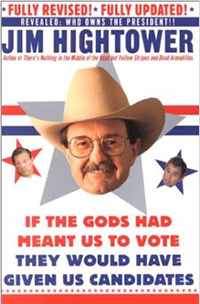
    If the Gods Had Meant Us to Vote They Would Have Given Us Candidates (2000)

    If the Gods Had Meant Us to Vote They Would Have Given Us CandidatesJim Hightower, America’s favorite subversive, is still mad as hell, and he’s not going to take it anymore. But he will give you a sizeable piece of his mind on Election 2000. This plain-talking, name-naming, podium-pounding populist zeros in on everything that ails us, from the global economy and media to big business and election winners everywhere. In his hard hitting commentary and hilarious anecdotes, Hightower spares no one, including the scared cows — and especially the politicians — who helped steer us into this mess in the first place. An equal opportunity muckrucker and a conscientious agitator for “We the People”, Hightower inspires us to take charge again, build a new politics for a better tommorow — and have a lot of laughs along the way.

    There's Nothing in the Middle of the Road But Yellow Stripes and Dead Armadillos (1998)
    There's Nothing in the Middle of the Road but Yellow Stripes and Dead ArmadillosRevised, and with a New Introduction by the Author

    “I am an agitator, and an agitator is the center post in a washing machine that gets the dirt out.”
    –Jim Hightower

    Hightower is mad as hell and he’s not going to take it anymore! He’s also funny as hell, and in this book he focuses his sharp Texas wit, populist passion, and native smarts on America’s political, economic, scientific, and media establishments. In There’s Nothing in the Middle of the Road But Yellow Stripes and Dead Armadillos, Hightower shows not only what’s wrong, but also how to fix it, offering specific solutions and calling for a new political movement of working families and the poor to “take America back from the bankers and bosses, the big shots and bastards.”

    “If you don’t read another book about what’s wrong with this country for the rest of your life, read this one. I think it’s the best and most important book about out public life I’ve read in years.”
    –Molly Ivins, author of Molly Ivins Can’t Say That, Can She?“When do we get to vote for Jim Hightower for president? Will somebody please tell me? When do we get to vote for Jim Hightower for president?.”
    –Michael Moore, author of Downsize This!

    “Listen to Jim Hightower. His is a two-fisted, rambunctious voice unafraid to speak truth to power, eloquently and clearly…He’s one of the best.”
    –Studs Terkel